

 info@silverliningfloorcare.co.uk



Learn how to safely clean natural stone floors without etching or staining. From daily care to what to avoid.
Read more
Published on 13 May 2026
By Johnny Czarnota, Founder of Silver Lining Floor Care
Dust free floor sanding is a modern approach to sanding wooden floors using advanced sanding machinery connected to powerful extraction systems. These systems capture dust at the source, significantly reducing airborne dust compared to traditional sanding methods. The result is a cleaner, healthier, and more efficient wood floor sanding process.
✔ Captures dust at the source
✔ Improves indoor air quality
✔ Reduces cleaning time
✔ Produces smoother finishes
✔ Not 100% dust-free, but very close
I still remember one of my early floor sanding jobs.
We were working on a lovely wooden floor in a family home. By the end of the day, there was a fine layer of dust on everything. The sofa, the shelves, even the hallway upstairs somehow joined the party. The client laughed it off. I smiled, but inside, I knew there had to be a better way.
That experience stayed with me.
Today, dust free floor sanding has completely changed how we approach wood floor restoration. It’s not just about sanding a floor anymore. It’s about doing it in a way that respects the home, the people in it, and the air they breathe.
If you’re exploring professional options, it’s worth understanding how a proper dust free floor sanding service is carried out in real homes and why it makes such a difference.
At its core, dust free floor sanding is a cleaner, more controlled way of sanding wooden floors.
Instead of letting dust fly freely into the air, modern sanding systems use a powerful extraction system that captures dust particles at the source. As the floor is sanded, the dust generated is immediately pulled away through hoses into sealed dust collection systems.
Now, let’s be honest for a moment.
Despite the name, it’s not completely dust free. A small amount of dust escaping especially around edges is normal. But compared to traditional sanding, the difference is remarkable.
In fact, most professional dust-free sanding systems capture around 90–99% of dust particles at the source, depending on the sanding machine and setup. That’s a significant improvement over traditional sanding methods, where a considerable amount of dust becomes airborne and spreads throughout the space.
I often tell clients:
“It’s not about removing every speck of dust, it’s about controlling it.”
And when you control the dust, the entire experience changes. The air feels lighter. The space stays cleaner. And the process feels far less intrusive.
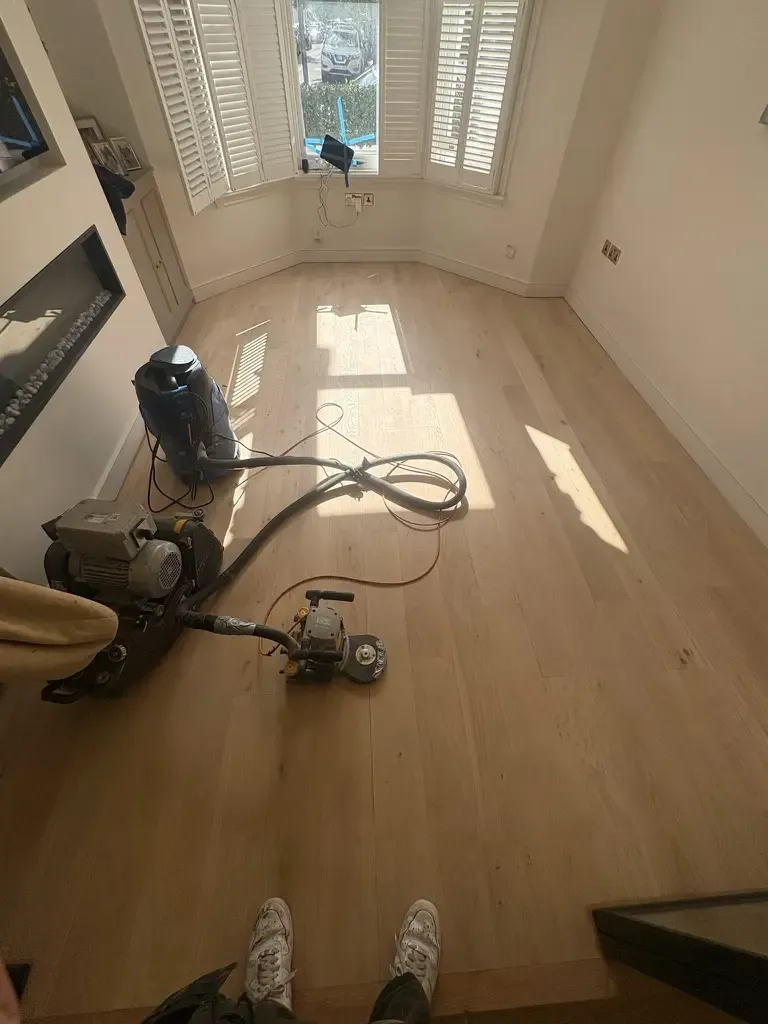
The sanding process itself hasn’t changed dramatically over the years. What has changed is how we manage the dust created during the work.
Here’s how a typical sanding process looks.
We start by assessing the condition of the floor. Every wood floor is different. Some have deep scratches. Others just need a light refinish.
Preparation ensures we choose the right sanding methods and protect surrounding areas.
This is where the main transformation begins.
A professional floor sander, connected to an extraction system, removes the top layer of the wood. As it moves across the floor surface, it captures dust at the source before it becomes airborne.
This is the key difference in modern floor sanding.
Edges and corners require a smaller sander.
This stage can produce a bit of fine dust, but modern dust collection systems still reduce the amount of dust significantly compared to traditional sanding.
We repair gaps and imperfections using wood filler.
Done properly, this blends seamlessly into the grain of the wood, restoring both strength and appearance.
We refine the floor using finer grits.
Because there is less dust settling on the floor surface, the result is smoother and more consistent.
Finally, we apply finishes such as oils, stains, or lacquers.
With less dust in the environment, there’s less risk of imperfections in the final result. The finish comes out cleaner, clearer, and more durable.
This full wood floor sanding and refinishing process is what allows us to restore wooden floors properly, not just improve how they look on the surface.
If you’ve ever experienced traditional sanding methods, you’ll understand why dustless sanding has become the modern standard.
I once returned to a home where we had completed a sanding project years ago using older techniques. The client joked they were still finding dust months later. We both laughed, but it highlighted the reality of traditional floor sanding.
Traditional sanding creates a considerable amount of dust. It spreads across the floor, settles on furniture, and lingers in the air. Cleaning after sanding can be a project in itself.
Dust free sanding offers a completely different experience, cleaner, calmer, and far more controlled.
Here’s how they compare:
| Feature | Dust-Free Floor Sanding | Traditional Floor Sanding |
| Dust Levels | Captures 90–99% of dust particles | High amount of dust generated |
| Air Quality | Cleaner indoor air, less airborne dust | Poor air quality during and after |
| Clean After Sanding | Minimal cleaning required | Extensive cleaning needed |
| Dust Settling on Furniture | Very little dust settles | Dust settles everywhere |
| Finish Quality | Smooth, fewer imperfections | Risk of dust getting trapped in finish |
| Comfort During Work | Can stay in parts of the home | Disruptive and messy |
If you’re weighing your options, it’s worth exploring a more detailed comparison of dust-free and traditional floor sanding methods to understand which approach best suits your space.
Fine dust from wood sanding can affect indoor air quality and irritate the lungs.
Dust free sanding significantly reduces airborne dust, helping maintain a healthier indoor air environment during and after the sanding project.
One of the biggest advantages is how much cleaner everything stays.
There’s far less dust settling on furniture or spreading into other rooms. That means less cleaning and less stress.
A clean surface leads to a better finish.
When dust doesn’t interfere with sanding and finishing, the final result is smoother and more refined.
With less dust to manage, the process becomes more efficient.
There’s less time spent cleaning after sanding, allowing projects to move forward more smoothly.
Reducing dust improves safety for everyone involved.
It creates a more comfortable space for both the homeowner and the professional carrying out the work.
If you’d like to explore this further, we’ve put together a full breakdown of the benefits of dust free floor sanding and why it’s become the preferred choice for modern flooring.
This is one of the most common questions I get.
The honest answer is no.
No sanding system can eliminate 100% of dust. There will always be a small amount of dust escaping, especially during edge work.
But compared to traditional floor sanding, dust-free sanding significantly reduces airborne dust and captures most of the dust produced.
The difference is clear from the moment the work begins.
It’s possible, but not always advisable.
Professional sanding machinery and dust-free sanding systems are designed for precision. Replicating that level of control with DIY equipment can be challenging.
More importantly, sanding wood floors requires experience. One mistake can damage the floor surface or remove too much of the top layer of the wood.
I’ve seen DIY projects that ended up costing more to fix than doing it professionally from the start.
Sometimes, the best decision is knowing when to ask for help.
Over the years, I’ve come to see floor sanding as more than just a technical task.
It’s about restoring something that people live with every day. A wood floor carries stories, footsteps, moments, memories.
Dust free floor sanding isn’t just about reducing dust. It’s about working with care, intention, and respect.
At Silver Lining Floor Care, that philosophy is at the heart of everything we do. From sanding wooden floors to full restoration work, we focus on delivering results that are not only beautiful but achieved in a cleaner, more mindful way.
If you’re ready to take the next step, you can learn more about our dust free floor sanding service and how we approach each project with precision and care.
Because in the end, a well-finished floor doesn’t just look better.
It feels better too.
Frequently Asked Questions
No, it’s not 100% dust-free, but modern systems capture around 90–99% of dust, making the process much cleaner than traditional sanding.
It reduces airborne dust by capturing particles at the source, helping maintain better indoor air quality during and after the sanding process.
Yes, it produces less mess, improves finish quality, and creates a more comfortable environment compared to traditional sanding methods.
In many cases, yes, you can stay in parts of the home since there is significantly less dust and disruption.
Most wood floors, including engineered wood, can be sanded using dust-free systems, depending on their condition and thickness.
Contact us for more information.