

 info@silverliningfloorcare.co.uk



Learn how to safely clean natural stone floors without etching or staining. From daily care to what to avoid.
Read more
Published on 01 Sep 2023
🚨 Had a leak or flood?
📞💦
Call us now on +44 20 3835 2294 — fast action prevents permanent damage! ⏳🪵
Wooden floors are a timeless feature in London homes, but they’re not invincible. Plumbing leaks, heavy rain, or even everyday spills can all leave their mark. Left untreated, water damage can cause cupping, warping, staining, or even permanent structural issues.
The good news? With quick action and the right expertise, most London wood floor water damage repairs can be carried out without the need for full replacement.
This guide covers:
Common causes of water damage
Prevention strategies tailored for London homes
Safe drying and restoration steps
When to repair vs. when to replace
Professional options for sanding, repairs, staining, and refinishing
Water damage can come from many directions — some sudden, some slow and hidden:
Plumbing leaks – burst pipes, faulty appliances, or leaky radiators.
Flooding or storm ingress – common in basement flats across London.
Spills and splashes – drinks, pet bowls, or wet shoes can leave stains if ignored.
Humidity – damp basements or poorly ventilated spaces allow timber to absorb excess moisture.
Knowing the source helps determine the right restoration strategy.
The best repair is the one you never need. Prevention saves money, stress, and preserves your floor’s lifespan.
Inspect plumbing and appliances regularly. Even a slow drip can saturate boards over time.
London homes swing between damp winters and dry, centrally heated interiors. Keep indoor humidity at 40–60% RH using a hygrometer. This balance prevents swelling in winter and cracking in summer.
💡 Caution: Drying too aggressively with a dehumidifier can worsen damage. The ideal drying condition is around 40% RH at 21 °C. If it’s warmer outside (above 21 °C), open windows and run small fans — often this is enough.
Install high-quality mats and consider a “shoes-off” policy to protect hallways from rainwater and grit.
Always blot spills immediately. Never rub, as this can spread the moisture deeper into the grain.
A strong finish adds resilience. Choosing the right wood floor staining and finishing option makes ongoing care easier and helps seal against light moisture.
When water hits wood, time is everything. Mould can begin forming within 24 hours if moisture is trapped, and untreated boards can start cupping or darkening fast. The good news? Most floors in London — whether in Kensington, Camden, or Fulham — can be saved if the right steps are taken quickly.
Stop the source — turn off leaking appliances or isolate the burst pipe.
Blot and extract water — use towels, a wet vacuum, or mops to remove standing water.
Ventilate the room — open windows if it’s warmer than 21 °C outside; use small fans to circulate air.
Avoid over-drying — don’t crank up big dehumidifiers. Too much force can crack the timber. Ideal drying is around 40% RH at 21 °C.
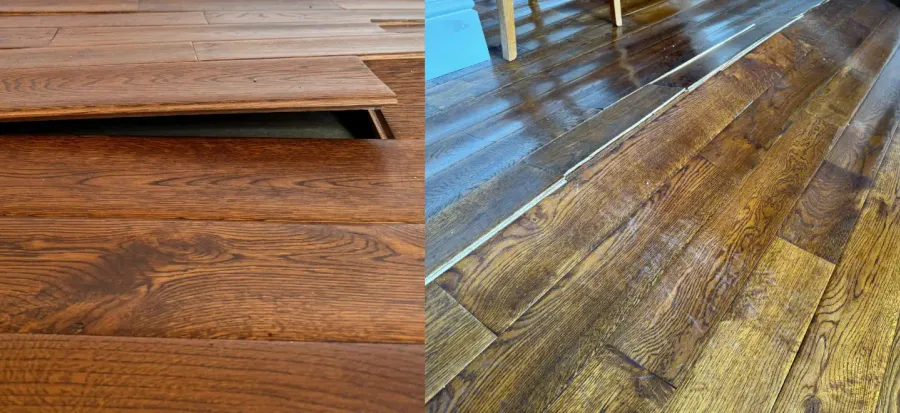
Lift a board if safe to do so — when a large amount of water has seeped underneath, gently lifting a single board allows moisture to escape. This prevents mould from being trapped and spreading.
💡 These first steps are about buying time and preventing mould. They won’t “fix” the floor — but they make professional restoration much more effective.
Once the floor is stabilised, our London wood floor restoration team can carry out:
Moisture testing & inspection 🔍
We check how far water has penetrated and whether the problem is local or widespread.
Controlled drying 🌬️
Using professional-grade equipment to bring boards back to safe moisture levels without causing further stress.Over-drying can crack boards — learn why balanced humidity matters in our Humidity for Solid Wood Floors guide.
Wood floor sanding & refinishing 🪵✨
If staining or cupping is light, sanding removes the marks and prepares the timber for a protective finish. Concerned about engineered wood floor? Read our blog on Can You Sand Engineered Wood Flooring?
Wood floor repairs 🔧
Swollen or buckled boards are replaced and blended seamlessly with the rest of the floor.
Wood floor staining & finishing 🎨
To even out colour differences and restore a consistent look across the space.
Wood floor installation (worst-case) 🏗️
When damage is beyond repair, we can lift and install new flooring — always advising when this step is truly necessary.
👉 Explore our wood floor restoration in London services to see the full range of repair, sanding, and refinishing options.
Water damage is one of the most common reasons homeowners contact their insurers — but claims can be stressful without proper documentation.
At Silver Lining Floor Care, we regularly assist London clients in areas like Kensington, Camden, and Fulham by:
Providing written reports — moisture readings, photos, and condition notes your insurer needs to process a claim.
Outlining repair options — from sanding and refinishing to full board replacement or new installation, with clear costs attached.
Recommending the right approach — insurers often want the most cost-effective solution, but we also explain what gives your floor the longest life.
💡 Does insurance cover water-damaged wood floors?
Policies vary, but most home insurance plans will cover “sudden and accidental” water damage (burst pipes, leaks, flooding). Long-term neglect or gradual moisture ingress may not be included.
👉 If you’re making a claim, contact us before work begins. We can inspect, document, and give your insurer a clear plan — making approval faster and ensuring your floor is restored properly.
Common signs include:
Dark or grey patches where water has soaked in.
Cupping (edges higher than the centre) or crowning (centre higher than edges).
Musty smells or visible mould.
Splintering or rough textures.
Stains that don’t clean away.
In most cases, yes. Even badly affected floors can often be dried, sanded, and refinished. What matters most is time — the sooner you act, the better the outcome.
Minor staining can be resolved with sanding and oiling, while deeper swelling may need partial replacement. Only in extreme cases (e.g., long-term standing water) is full replacement required.
Recently, a client in London contacted us when water seeped through their ceiling, damaging their oak hallway floor.
We first assessed whether to restore only the affected area or the entire floor.
To maintain a seamless look, the client chose full restoration.
We carefully planked out damaged boards to protect underfloor heating.
Once dried under controlled conditions, we sanded and refinished with oil for a smooth, durable finish.
The result? A floor that looked brand new, with the underfloor heating system preserved.
Water damage on wood floors can feel overwhelming, but it doesn’t have to mean replacing your entire floor. With careful prevention, quick response, and professional restoration, your timber floors can be saved — often to look better than ever.
👉 Explore our full wood floor restoration services to see how we can help.
Don’t wait for damage to spread — we offer emergency callouts across London.
Get a free consultation and a tailored restoration plan from Silver Lining Floor Care.
Available across Kensington, Camden, Fulham, Chelsea, and all London boroughs.
FAQs: Water-Damaged Wood Floors in London 💧🪵
Yes — in most cases. If dealt with quickly, many London wood floors can be dried, sanded, and refinished without needing replacement. Even if boards are slightly cupped or stained, our wood floor sanding and refinishing service can usually restore them. Severe swelling or mould may require repairs or replacement.
Ventilation is the first step — open windows (if it’s warmer than 21 °C outside) and use small fans to move air. Aim for 40% relative humidity at 21 °C for safe drying. Avoid cranking up dehumidifiers — over-drying can crack timber. If a lot of water has seeped underneath, lifting a single board can help prevent mould from spreading.
Mould can begin forming within 24 hours if moisture is trapped. That’s why removing standing water and ventilating the space quickly is critical. Once mould sets in, restoration becomes far more complex — sometimes requiring full board replacement.
Most policies cover sudden and accidental damage — such as burst pipes, radiator leaks, or flooding. Gradual dampness or long-term neglect is usually excluded. We provide detailed inspection reports with photos, moisture readings, and costed repair options to help speed up insurance claims.
Repair – if damage is limited to a few boards, or the floor only shows staining or mild cupping. Wood floor repairs can make it seamless again.
Replace – if the floor has widespread buckling, deep mould growth, or has been submerged for days. In that case, wood floor installations may be the best long-term option.
Look out for:
Dark or grey patches
Musty smells or visible mould
Cupping or crowning of boards
Rough or splintered textures
Stains that won’t clean away
If you see these, act quickly. Fast response can mean the difference between a sanding job and a full replacement.
Yes, but it depends on the wear layer. Some engineered floors can be sanded once or twice; others are too thin. Our inspection will confirm whether sanding is safe. Read more in our guide: Can You Sand Engineered Wood Flooring?.
Costs vary depending on the severity and the treatment needed:
Deep clean & recoat – from £10–£20 per m²
Sanding & refinishing – from £25–£70 per m² or more
Repairs or replacements – from £35–£65 per m² depending on wood type and pattern
For an accurate quote, we offer free site visits across Kensington, Camden, Fulham, Chelsea, and all London boroughs.
We cover all London boroughs, including Kensington, Chelsea, Camden, Fulham, Hampstead, Islington, Shoreditch, and Canary Wharf. Emergency callouts are available for severe leaks and floods.
Contact us for more information.