


 info@silverliningfloorcare.co.uk



Learn how to safely clean natural stone floors without etching or staining. From daily care to what to avoid.
Read more
Published on 27 Nov 2025
Since 2004 we have sanded and finished floors across London, and one question comes up more than any other. It usually arrives as a single word: varnish.
Almost everyone who contacts us uses it. Almost nobody means the same thing by it. Some want colour. Most want the thing that stops their floor being ruined. So before comparing anything, it is worth separating what people say from what they actually need.
In about 99 cases out of 100, the person writing to us uses the word varnish. In 99.9 of those, what they want is a finish that will protect their floor. That is a lacquer or an oil.
The word itself is imprecise, and that is nobody’s fault — it is the word on the tin in every DIY shop. Strictly, varnish means a traditional resin-in-oil coating, slow to dry, prone to ambering with age. What goes on a professionally finished floor today is a lacquer — usually a two-component waterborne product — or a hardening oil. Bona Traffic HD, Loba Supra, Pall-X 98 are lacquers, not varnishes, whatever the search box says.
None of that matters to the result. It matters to the conversation, because “I want my floor varnished” and “I want my floor a different colour” are two different jobs, and the second one still needs the first.
This is the part worth internalising, and it is simpler than the internet makes it.
Colour is optional. Protection is not. A floor with colour and no protective coat is a floor with no protection at all. Whichever route you take to the colour, something has to go over it — a lacquer or an oil.
The usual “stain first, then varnish” advice describes one of these and ignores the other two. All three are in normal use.
Morrells Light Fast Stains are the ones we see most in this category. They are spirit-based and they sit on the surface of the wood rather than soaking into it. Water-based versions exist and behave the same way — on the wood, not in it.
They are chosen for one reason above all: a Morrells stain can be lacquered after about an hour. Set that against the 12 hours to several days a coloured oil needs and, on a job where the customer wants their house back, the difference is a day or two of everyone’s life.
The spirit-based ones are on their way out. They smell, and they are unpleasant and toxic to work with. In Germany this is already law — alcohol-based primers are no longer permitted for indoor use. It is only a matter of time before the same rule reaches the UK, and we would rather move ahead of it than wait to be told.
This is what we use for most coloured floors: Pallmann Pall-X 333 or Bona Craft Oil, available with colour or without. They are two-component systems, which means a hardener is mixed in, and they penetrate the timber rather than lying on top of it.
The colour is carried in the oil, so it goes in with the protection rather than underneath it. That is a genuinely different approach from stain-then-coat, and for floors it is usually the better one.
It is also the step that sets the timetable. Pall-X 333 needs anywhere from 12 hours to several days before it can be lacquered, depending on the timber and the weather. Smoked oak sits at the slow end. Nothing about that wait can be hurried, and it is the main reason a coloured floor takes longer than a clear one.
Colour can also be added to Pallmann Magic Oil 2K — the oil that does the protecting. Here the pigment arrives with the finish rather than underneath it, in one step.
Pigment can be carried in a lacquer, and some floors are finished that way. We do not work like that.
Our colour goes into the timber or into the oil, never into the clear coat on top. That is a deliberate choice about what happens years later, not a preference about how the floor looks on the day it is finished.
Because the colour sits in the timber and the lacquer above it is clear, a coloured floor can still be buffed and re-coated. The colour is not in the layer being worked on, so it does not come off with it.
There is a catch, and it is about timing rather than product. A buff and coat is done before the lacquer wears through. The machine only abrades the existing coat lightly, enough for the new one to bond to it — it does not strip the floor back. It is maintenance, not rescue.
Leave it until the finish has actually gone and that option closes. Then it is sanding, and the colour goes with it.
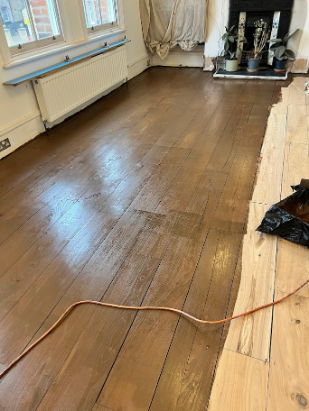
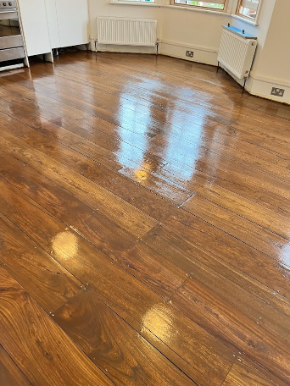
If you want the timber to look like better timber — warmer, darker, more even — you are choosing a colour route, and then a protective coat over it.
If you are happy with the wood and want it to survive the next ten years, you do not need colour at all. You need the coat.
Either way the honest answer to “should I varnish or stain my floor?” is that the question contains a false choice. Nobody stains a floor and stops.
Rates move with the floor plan, the furniture and the access, so treat these as orientation rather than a quote:
Every coat needs time to dry before the next one goes on, and a coloured oil can need anything from 12 hours to several days before it can be lacquered. That wait is the same number of hours in a small bedroom as in a large reception room — but in the small room there are far fewer square metres to spread it across. The labour does not shrink with the floor.
Furniture does the same thing. If there are pieces to move room by room, a two-day job routinely becomes four days, and the rate per square metre rises to match.
A surprising amount can be worked out before anyone turns up. Send photos, rough measurements and a description of what is on the floor now, and the estimate will be close. The more you can tell us, the more accurate it gets.
The visit confirms rather than discovers: the true condition of the boards, moisture readings, and the handful of other things that can move a price once someone is standing on the floor.
Whatever goes on top, the result is decided before any of it is opened. Sanding grit matters: go too fine before a colour and the timber will not take it evenly. Softwoods and pine are the ones that blotch, and they are exactly the floors people most often want to darken.
This is the step where DIY colour jobs go wrong, and it is not recoverable with another coat. It is recoverable by sanding back and starting again.
You do not have to work it out before you call. Describe the floor and what you want it to look like, and we will tell you which route gets there. That is a faster conversation than trying to pick the right word first.
Send photos over WhatsApp on 07850 631877 and we will advise on your particular floor.
Frequently Asked Questions
Neither product is universally “better”; they simply serve different purposes. The right choice depends on what the wood needs and how the surface will be used.
Varnish is a protective coating. It sits on top of the wood and creates a durable film.
Stain is a colouring treatment. It penetrates into the fibres and changes the appearance but offers very little protection on its own.
Varnish is a durable and protective finish, but there are a few points homeowners should be aware of:
Surface Wear Is More Noticeable: Because varnish sits on top of the wood, scratches and scuffs often show more clearly than they do with penetrating stains or oils.
Some Types Can Yellow Over Time: Traditional oil-based varnishes may develop a warmer tone as they age. This is natural but can affect colour consistency.
Note: Modern formulations, including many water-based varnishes, are designed to stay clearer for longer.
Longer Application and Curing Time: Varnish usually needs several coats with careful drying periods in between, which can extend the project schedule.
Less Natural Wood Feel: The protective film reduces the tactile texture of the wood.
However, it’s worth mentioning that varnish is available in a range of sheens, including matt finishes. Matt varnish avoids the glossy look and gives a more natural appearance while still providing surface protection.
Repairs Can Be More Involved: Spot repairs rarely blend perfectly. Achieving an even result may require refinishing a wider area.
No, they are fundamentally different: stain is a colourant that penetrates the wood, while varnish is a clear finish that forms a protective film on the surface.
Contact us for more information.