


 info@silverliningfloorcare.co.uk



Learn how to safely clean natural stone floors without etching or staining. From daily care to what to avoid.
Read more
Published on 13 Feb 2026
Oil has a sneaky way of showing up in life at the most inconvenient times. One small spill, one dropped pan, and suddenly your beautiful stone floor is holding onto a dark oil stain like it plans to keep it forever. I have been working with natural stone surfaces since 2004, and if there’s one thing I’ve learned, it’s this: stone remembers everything.
But the good news is that with the right approach and a little patience, you can remove even stubborn stains and restore your floor’s original appearance.
This is the “panic moment” guide. Follow these steps immediately when a spill happens:
Keep this mini-guide handy, it’s saved many homeowners from unnecessary stress.
Stone, even polished granite and marble, is naturally porous. That means oil doesn’t just sit on top; it sinks in. Once it does, simple wiping will never fully remove the stain. This is also why everyday stone maintenance requires a different approach than standard floor cleaning, something we explain in more detail in our guide on how to clean stone floors properly.
Research shows that higher porosity directly increases the depth and rate at which liquids are absorbed into natural stone (Water absorption and drying features of different natural building stones – ScienceDirect).
I still remember a family from Kensington who spilt olive oil during a Sunday roast. They scrubbed and scrubbed, but all they managed to do was spread the stain deeper into the tile and grout lines. When I arrived, they looked defeated.
“Don’t worry,” I told them. “Stone is patient. And we’ll be patient with it.”
Different surfaces require different approaches. That’s why understanding your type of stone matters before using any cleaner, poultice, or chemical.
| Stone Type | Porosity Level | Acid-Sensitive? | Risk of Etch Marks | Best Cleaning Approach |
| Marble | Low | Yes | High | Neutral cleaner, gentle poultice |
| Limestone | Very High | Yes | High | Mild detergent, baking soda poultice |
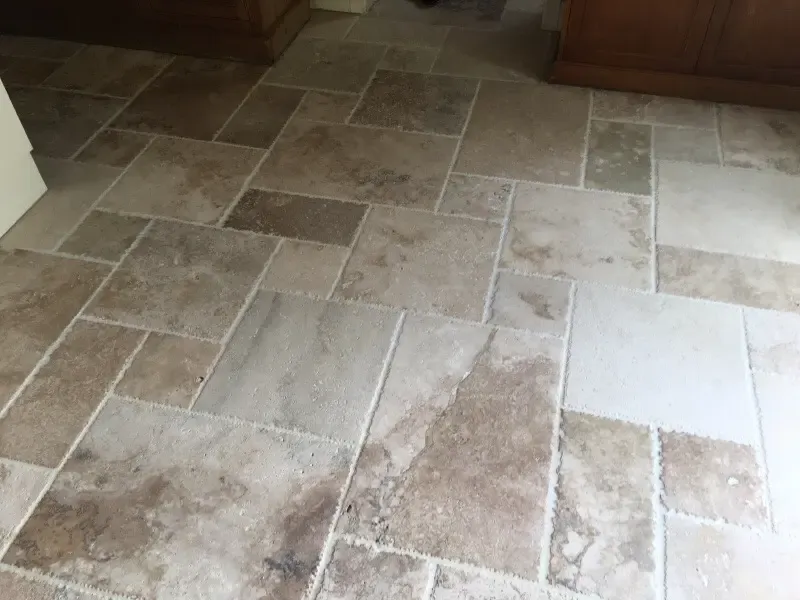
| Travertine | Medium–High | Yes | High | Soft cloth + poultice; avoid acids |
| Granite | Low–Medium | No | Low | Stronger poultice, acetone if safe |
| Slate | Medium | No | Low | Standard poultice, soft scrubbing |
| Porcelain Tile | Very Low | No | None | Standard tile cleaning, detergent |
| Concrete | High | No | Low | Poultice, sealant, polishing (if polished) |
Oil makes stone extremely slippery. Before you begin stain removal, make sure you’re protecting:
Anyone walking through the room
Slips, trips, and falls remain one of the leading causes of workplace injuries, with contaminated floors being a major factor (Work-related slip, trip and fall injuries reported by National Health Service staff in Great Britain: how many are due to slipping? | Injury Prevention).
Ensure the space is well-ventilated.
Here’s a straightforward kit that works for most oil and grease stains:
Having these items ready keeps your process smooth and stress-free.
Fresh oil stains are always the easiest to lift from a stone surface, as long as you act intentionally. This is the fuller version of the cheat sheet, with more explanation and care.
Use a soft cloth or paper towel to gently blot the oil.
Avoid rubbing — it pushes oil deeper into porous surfaces like marble, limestone, and textured stone tiles.
Sprinkle baking soda, talc, or any dry absorbent.
Let it saturate for 10–15 minutes to draw out surface oil. Sometimes a poultice must be left for even up to 48 h.
Combine warm water with a few drops of neutral detergent or stone-safe cleaning product.
Avoid harsh products (low on the ph scale, acids. Alkaline products are typically safe to use on stone). They can etch or dull delicate stone.
Use a soft or stiff brush depending on your type of stone.
Work slowly and steadily; this isn’t the moment for force.
Use fresh, clear water to remove detergent residue.
Leftover soap can attract dirt and make the stain look worse later.
A damp stone may disguise the stain, so dry the area fully before evaluating.
If the stain persists, don’t worry; it simply means the oil has penetrated more deeply.
That’s when we move to the heavy lifter: the poultice method in the next section.
This is the deeper-level approach, ideal for old oil or stains that have fully penetrated the surface.
A poultice is essentially a paste that draws contaminants upward as it dries. The Natural Stone Institute confirms that a poultice should be applied thickly and left for 24–48 hours to pull oil out of the pores effectively.
Marble, limestone, and travertine are acid-sensitive, so avoid acidic products like vinegar. Granite and slate tolerate stronger agents but still require thoughtful handling to protect the surface.
Because stone is naturally inconsistent. Some areas absorb more oil than others. Studies show that pore distribution and microstructure can vary significantly across a single slab, affecting how stains behave and why some spots resist cleaning more than others
If you’ve tried multiple poultice cycles and the stain still won’t budge…
Or if the stone is etched…
Or if you want a guaranteed restoration…
That’s when it’s time to call a professional stone specialist.
At Silver Lining Floor Care, our professional-grade tools and experience going back to 2004 allow us to restore surfaces safely and effectively, often in ways DIY methods can’t.
Professional help is available when stains feel too stubborn or surfaces too delicate.
A stain may look permanent, but with the right approach, you can always restore the surface of your stone. Whether you’re tackling oil and grease stains, dealing with old oil, or simply trying to protect the surface, the key is understanding the stone’s needs and working with them, not against them.
At Silver Lining Floor Care, we’ve built our reputation on treating stone with respect, patience, and expertise. If your stone floor needs deeper help than DIY methods can offer, we’re always here to guide you back to clarity and confidence.
These reputable sources were referenced to ensure accuracy, trustworthiness, and alignment with industry standards:
Frequently Asked Questions
Yes, baking soda can remove oil stains from stone because it absorbs oil from the stone’s pores, especially when used quickly or as part of a poultice for deeper stains.
Yes, dried oil stains can usually be removed, but they require a poultice and patience, as the oil must be drawn out of the stone rather than cleaned from the surface.
Short answer, NO and using them can permanently damage the stone.
It’s a common assumption that strong household cleaners equal better results. Unfortunately, when it comes to natural stone, vinegar and bleach often do more harm than good.
Why is vinegar not suitable?
Vinegar is acidic. While acids may cut through some household grime, they do not break down oil, and on stone surfaces like marble, limestone, and travertine, they can cause etching — dull, pale marks where the stone itself has been chemically damaged.
Sealing helps slow oil absorption but does not make stone completely stain-proof.
Absorbent powders and neutral-pH cleaners are safest and most effective for oil stains on stone.
Contact us for more information.